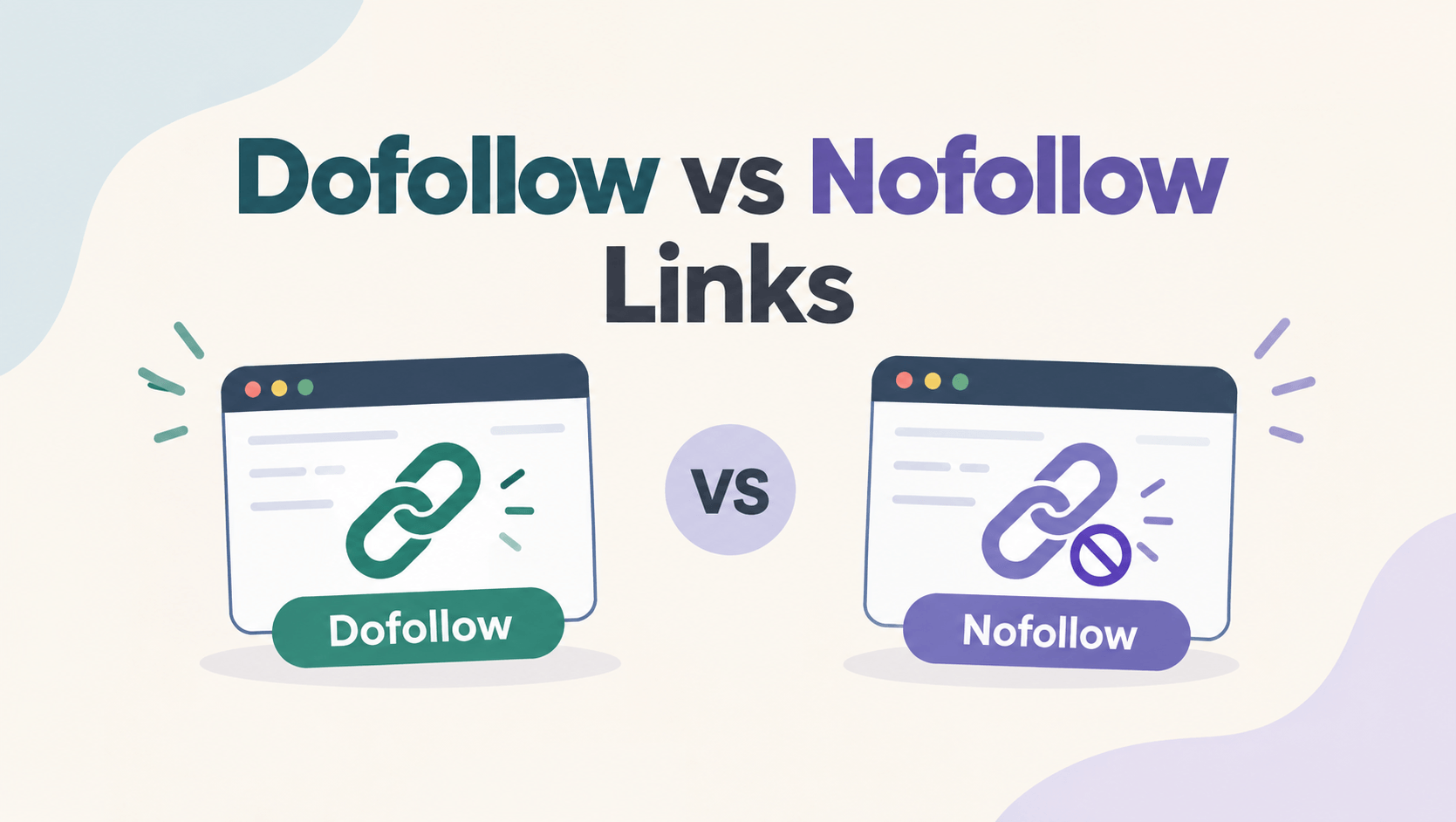
Links are known to be one of the most crucial components of SEO. They play a role in helping users navigate through the web and helping search engines to identify and interpret pages. However, not all links will provide the same kind of signals to search engines.
In the SEO world, you will often come across the terms dofollow and nofollow links, which will help you in understanding the worlds of backlinking and making the right choices in your link-building efforts.
What Is a Dofollow Link?
The term dofollow link refers to a standard link that does not have any special rel attribute. Its definition goes beyond HTML, since it does not refer to any specific HTML attribute; it is defined in the SEO community.
For example:
<a href=”https://example.com”>Visit Example</a>
Because there is no rel=”nofollow” or other qualifying attribute, this is considered a regular or “dofollow” link.
Receiving a link from another site indicates that someone has recognized your website as useful. Thus, links help Google learn more about different relationships between web pages.
Also Read: What Is Link Building in SEO
Benefits of Dofollow Links
Dofollow backlinks can provide several SEO and marketing benefits:
- Potential ranking signals: Regular editorial links can contribute to Google’s ranking systems.
- Authority and credibility: A relevant link from a reputable website can strengthen your site’s perceived authority.
- Referral traffic: Visitors can click the link and discover your website.
- Faster discovery: Links can help search engines discover content.
- Brand exposure: Being mentioned on relevant websites can increase awareness of your brand.
However, having a backlink doesn’t automatically equate to better ranking. The quality, relevance, context, and general link profile of the link itself play a crucial role.
What Is a Nofollow Link?
A nofollow link uses the rel=”nofollow” attribute:
<a href=”https://example.com” rel=”nofollow”>Visit Example</a>
According to Google, it is best to use nofollow when you want to link to a website, but do not want to make it seem as if you are providing an endorsement.
For example, you can use nofollow when linking to websites you do not trust completely or when the relationship does not match Google’s other linking categories.
It is crucial to highlight that nofollow does not mean the link will not be noticed by Google, because the nofollow tag has been a suggestion and not a command since 2019.
Dofollow vs Nofollow: Key Differences
| Factor | Dofollow | Nofollow |
| HTML attribute | No special attribute | rel=”nofollow” |
| Can be used as a ranking signal | Yes | Google treats it as a hint |
| Can drive referral traffic | Yes | Yes |
| Helps users discover content | Yes | Yes |
| Usually used for | Editorial links | Unendorsed or untrusted links |
| Guarantees ranking improvement | No | No |
The biggest misconception is that a nofollow link is completely useless. It can still bring referral traffic, brand visibility, exposure, and potential secondary SEO benefits.
Are Dofollow Links Better Than Nofollow Links?
In case you aim to create backlinks for the purpose of SEO, dofollow links gained naturally can be important. However, this does not suggest that you should limit your backlinks to dofollow links only.
A naturally made backlink profile consists of various kinds of backlinks. For instance, a website may get backlinks from blogs, nofollow backlinks from social media, user-generated links, and links from paid media.
Instead of focusing only on whether a link is dofollow or nofollow, consider:
- Is the website relevant to your industry?
- Is the page trustworthy?
- Does the website receive real traffic?
- Is the link placed naturally within useful content?
- Can the link send relevant referral traffic?
- Was the link earned naturally?
A relevant nofollow link obtained from a well-known website can bring even more benefits to your business than a dofollow link coming from a low-quality irrelevant site.
When Should You Use Nofollow Links?
Nofollow should be applied whenever no other link attributes fit and it is beneficial to avoid associating your website with the page that is being linked to.
For instance, if the website is publishing a post covering a non-credible source, the publishing site may want to include a reference to that source without endorsing it.
The approach that involves using a nofollow link will be suitable. However, this does not mean that one should apply nofollow tags to all external links. Normal, editorial links to credible resources do not require nofollow.
Do Nofollow Links Help With SEO?
Yes, but not necessarily in the traditional “link equity” sense.
A nofollow link can still:
- Bring visitors to your website
- Increase brand awareness
- Generate potential leads
- Help people discover your content
- Create opportunities for future mentions and backlinks
- Contribute to a diverse backlink profile
Google’s current documentation makes clear that nofollow is a hint and that links carrying these attributes may still be discovered or evaluated in Google’s systems.
Therefore, it is a mistake to evaluate every backlink solely by its dofollow or nofollow status.
How Should You Build Backlinks?
Instead of merely chasing dofollow backlinks, it’s wise to prioritize excellence and relevance.
Produce worthwhile content that other websites will want to cite. Build up basic relationships and connect to relevant publications, offering them professional insight and valuable resources, and ultimately getting mentioned by respected industry publications.
Avoid creating or buying links that are created for manipulative purposes according to search engine rankings. Google sees links manufactured mainly for ranking purposes as spam content.
Final Thoughts
Although the distinction between dofollow and nofollow links is critical, the difference between the two should not be the only consideration of your SEO plan.
Regular editorial links can help you convey important signals for rankings, while nofollow links can retain the potential of generating traffic, online visibility, and various kinds of business. Sponsored and user-generated links should be distinguished as rel=”sponsored” and rel=”ugc” accordingly
Instead of asking, “Is this backlink dofollow?”, ask a bigger question:
“Is this a relevant, trustworthy link that provides genuine value to users?”
That mindset will help you build a stronger and more sustainable link profile over time.
Leave a Reply